Oct
26
2026
The turbocharger on the first-generation 6.7L Powerstroke is one of the most discussed parts on the 2011-2014 Super Duty. Ford replaced it with a completely different design for 2015, and the aftermarket has since built several kits that put the newer-style turbo on early trucks. This post covers how the original turbo works, why it has a reputation for failing, the symptoms to watch for, and the retrofit options available.
For the 2011 model year, Ford launched the 6.7L Powerstroke with a Garrett VNT DualBoost turbocharger. Garrett describes the design as combining the airflow of two compressor wheels within a single turbo. The two wheels are actually one piece with mirror-image blades, running in a compressor housing with two separate inlets and a single common outlet. The goal, according to Garrett, was near two-stage performance from a single unit that fit in a tight space.
The turbine side is variable geometry (VGT), so the turbo can respond quickly at low engine speed and still flow at higher rpm. The unit is commonly called the GT32 SST, which stands for single sequential turbocharger.
BD Diesel’s installation instructions for its retrofit kit point out that the 2011-2014 6.7L used two different turbos:
According to BD, the cab and chassis version continued through 2016. Know which one your truck has before you order parts.
Banks Power, which tore down a 2011 6.7L turbo on video, says turbo failures were common on 2011 and 2012 trucks because of weak ceramic ball bearings. Banks reports that a switch was made to steel ball bearings after that. The change did not keep the design in production, and Ford moved to a single-wheel compressor for 2015.
BD Diesel describes the factory GT32 as a petite turbo. In BD’s words, “the moment you increase the engine output, restrict the turbo intake, or tow heavy loads, the factory GT32 turbocharger becomes consumable.”
The dual-wheel design also hangs a lot of mass out on the end of the shaft. Gale Banks compared it to “a popsicle on a stick” during his teardown. A small turbo that has to spin very fast to make the boost the engine wants is more exposed to overspeed. Overspeed is one of the failure causes Garrett lists for turbos in general.
Garrett says that most turbo failures are related to oil, through oil starvation or oil contamination, rather than to manufacturing defects. Garrett lists these contributing habits:
Even on a turbo with a known design weakness, oil quality and how the truck is driven still matter.
Garrett groups turbo trouble into a few warning signs:
Garrett also notes that when bearing surfaces wear and the oil can no longer control the shaft, there is usually a sharp increase in noise. Oil can then leak past the turbine-end seal.
Garrett’s guidance is to diagnose before replacing, because turbo damage is often a symptom of another problem. Before you blame the turbo, check:
If you replace a turbo without fixing the underlying cause, the new one can fail the same way.
For 2015, Ford replaced the SST with a conventional single-compressor Garrett GT37-based VGT. According to BD, the retrofit design uses a 61mm single-sided compressor wheel. KC Turbos describes the 2017+ style turbo as a journal-bearing design known for overcoming most of the shortcomings of the stock 2011-2014 ball-bearing turbo.
Ford Performance describes its own 2015-2016 turbo kit as having “higher performance capability than pre-2015 turbos.”
The newer turbo does not simply bolt in. The mounting pedestal, intake and exhaust connections changed. Each kit handles that differently.
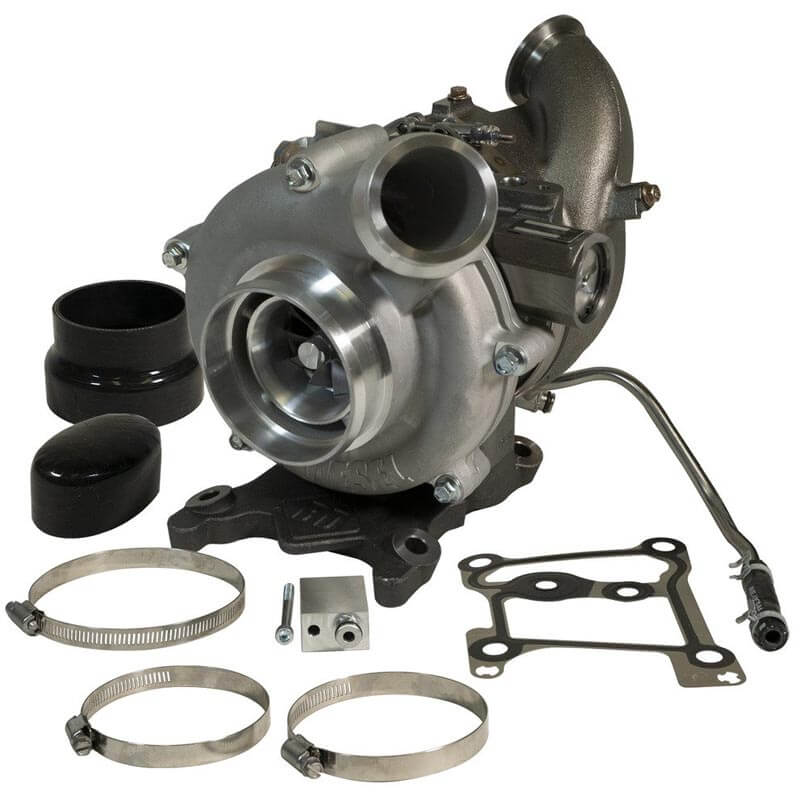
Ford Performance’s M-TURBO-67 is an all-Ford kit. Ford lists these contents:
There are two notes on Ford’s own listing:
Ford does not officially validate this kit for 2011-2014 trucks, even though it is widely used for that swap. Factor that in, along with the emissions notice Ford includes on the part.
BD Diesel designed its retrofit to put a GT37-based turbo from 2017+ trucks onto 2011-2014 pickups and 2011-2016 cab and chassis trucks. BD uses its own compressor housing, turbine housing and pedestal so the GT37 fits in the factory location. According to BD’s instructions, the factory intake, hot pipes, downpipe, exhaust manifold, heat shield and turbo outlet pipe are reused.
BD lists the two kits this way:
Both kits have the same requirements and restrictions, per BD:
KC Turbos’ Warlock retrofit fits a 2017+ style turbo to 2011-2014 trucks. KC says it needs less modification than the Ford Performance kit. KC offers it with its own upgraded turbos or a Garrett replacement turbo. KC states that updated tuning is required and that the kit is not available for sale in California.
No Limit Fabrication makes a retrofit kit for running a 2015+ style turbo on early trucks. Check the kit contents and tuning requirements with the manufacturer before you buy.
The answer depends on how you use the truck and what condition the original turbo is in.
A retrofit makes the most sense if:
Things to weigh before you commit:
Whatever turbo you choose, Garrett’s basics apply:
Garrett also recommends new air, oil and fuel filters and clean oil when you install a replacement turbo. Prime the new turbo with oil before first start-up.
The SST was used on 2011-2014 pickups. BD notes that cab and chassis trucks used a traditional single-compressor GT32 through 2016. Ford moved pickups to a GT37-based turbo for 2015.
According to Banks Power, ceramic ball bearings were the problem on 2011 and 2012 trucks, and a switch to steel ball bearings followed.
Yes, for the kits covered here. Ford Performance says calibration is not included with M-TURBO-67. BD requires an emissions-compliant calibration, and KC requires updated tuning.
BD and KC both say their retrofit kits are not for sale for California vehicles. Check the emissions status of any kit before you buy.
Garrett recommends checking the air intake, fuel injection, exhaust and DPF, oil supply and crankcase pressure before you replace a turbo. Loss of power, noise, smoke and oil use can all come from other problems.
Full Force Diesel carries retrofit options for early 6.7L trucks:
Not sure which turbo your truck has or which kit fits? Send our team your VIN and we will help you sort it out.
Sources
*Free shipping applies to qualifying orders over $199 shipped within the contiguous U.S. Oversized, freight and select items are excluded.