Oct
21
2026
If you own a 6.7L Powerstroke, you have probably heard about the CP4. It is the most talked-about weak point on this engine. It comes up in nearly every “common problems” list and in a steady stream of forum threads. This post covers what the pump is, how it fails, the warning signs, and the two most common ways owners protect themselves: a disaster prevention kit (DPK) or a DCR pump conversion.
The Bosch CP4.2 is the high-pressure fuel pump on the 6.7L Powerstroke. S&S Diesel Motorsport describes it as the pump “in every 2011+ 6.7L Power Stroke.” S&S builds both its DPK and DCR conversion to fit 2011 and newer Super Duty trucks.
Ford did change pump configurations between generations. If you are buying a replacement pump or a protection kit, confirm fitment with your VIN, your production date and the pump that is actually installed on your truck. It is also worth checking your VIN for open recalls or service campaigns before you spend money.
The CP4.2 is lubricated by the diesel fuel passing through it. S&S explains the known failure this way: the pump’s roller lifters can rotate on the cam lobe, so they skid and grind instead of rolling. MotorTrend describes it as metal-on-metal contact that air inside the pump makes worse.
The pump itself is not the expensive part of a failure. The problem is where the metal goes. In the stock setup, debris from a failing CP4 can travel into the injectors, fuel rails, lines and pressure regulators. That is why a pump failure often becomes a complete fuel system replacement.
Ford’s 6.7L fuel system service job aid lists the contaminants that cause premature pump and injector wear and metal debris:
The supply side also matters. The 6.7L watches low-side fuel pressure and will warn you and derate the engine if it sees low pressure. Industry write-ups note that the CP4 is especially sensitive to insufficient supply pressure. Restricted filters, a weak supply pump, air leaks and running the tank dry can all starve the pump.
You will see “U.S. diesel has poor lubricity” repeated a lot. Treat it with some care. U.S. diesel spec (ASTM D975) does include a lubricity requirement. The bigger, controllable risks are water, contamination, starvation and neglected filters.
Ford’s service job aid lists these symptoms of fuel contamination damage:
A low rail pressure code such as P0087 means rail pressure is lower than commanded. It does not tell you whether the problem is before, inside or after the high-pressure pump. A clogged filter, weak supply pump, air in the fuel or a leaking injector can set the same code.
Proper diagnosis checks low-side supply pressure first, then compares commanded and actual rail pressure. Ford’s guidance is that metal debris found at the pump’s control valve or in the high-pressure system means the complete high-pressure system needs replacement, not just the pump.
If you suspect a misfuel, such as gasoline or DEF in the tank, do not start the engine.
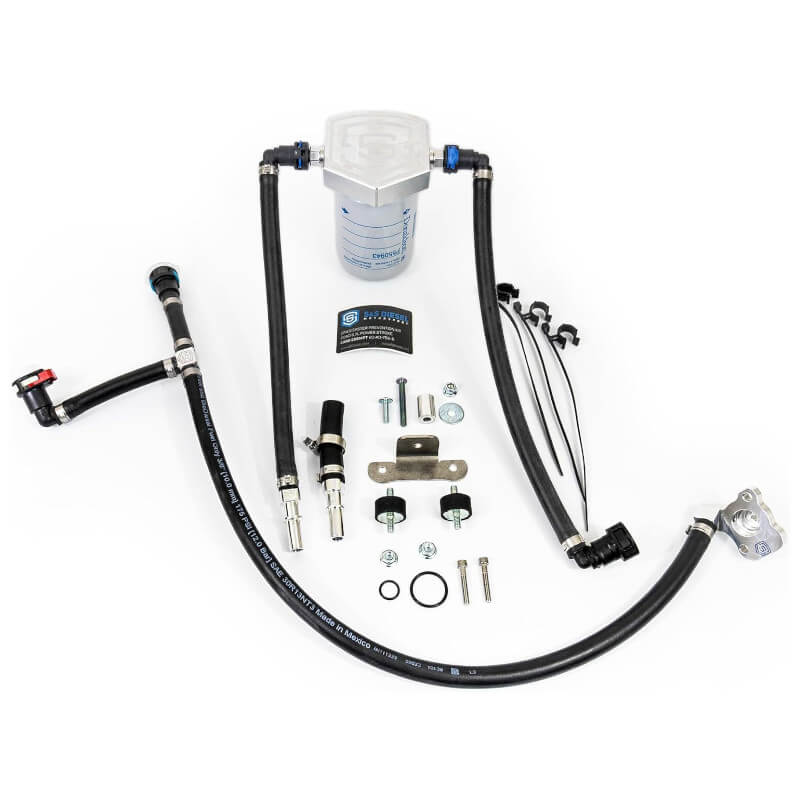
A disaster prevention kit is a bypass and filtration kit. The best known is the S&S Diesel Motorsport Gen 2.1 kit. According to S&S, it does two jobs.
S&S says that if a CP4 fails with the Gen 2.1 kit installed, you replace the return filter and the pump, or upgrade to a DCR. You can check that the kit did its job by inspecting the pump’s metering unit, which should be clean. S&S also published a test in which it deliberately damaged a CP4 and drove the truck about 180 miles, including towing. Diesel World reported that on teardown, the injectors, rails, return lines and tank were protected.
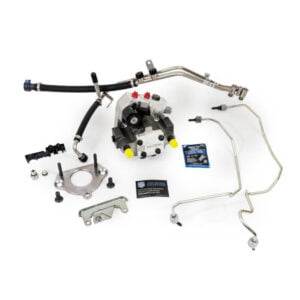
The DCR conversion takes a different approach. Instead of containing a CP4 failure, it removes the CP4. The S&S Diesel Motorsport CP4-to-DCR conversion (part 6.7F-DCR-1) replaces the Bosch CP4.2 with a two-piston Stanadyne DCR (Diesel Common Rail) pump. S&S co-developed it with PurePower Technologies.
Per S&S:
There is no single right answer. Here is how owners and shops usually frame it:
If your truck has already lost a CP4 and the fuel system is being rebuilt, that is a natural time to consider a DCR. If your pump is healthy and you plan to keep the truck, a quality DPK is the lower-cost layer of protection.
No part replaces good fuel habits. These steps help whichever path you choose.
A Ford dealer’s 6.7L maintenance guide says to change both fuel filters every third oil change, every 22,500 miles, or when the message center tells you, whichever comes first. Under severe use, such as extensive towing, long idle time or extended low-speed driving, the interval is every 15,000 miles or 600 engine hours. Check your owner’s manual for your model year. Use quality filters made for the 6.7L, because a restricted filter can starve the pump.
The 6.7L’s fuel conditioning module separates water from fuel. When enough water collects, the truck turns on a Water in Fuel (WIF) warning. Drain it promptly when that warning appears. If water keeps showing up, find out why. It may be a bad fuel source or a water problem in the tank.
Fix air leaks. Do not run the tank dry. Take a “low fuel pressure” warning seriously, because supply problems are hard on the CP4.
S&S describes the Bosch CP4.2 as standard on 2011 and newer 6.7L Powerstroke trucks. Ford revised pump configurations between generations, so confirm by VIN before ordering parts.
No. A DPK does not change what happens inside the pump. It is designed to keep debris out of the injectors, rails, lines and tank if the pump fails.
Not for the S&S DCR. S&S says it needs no ECU calibration and runs on the stock tune.
S&S says no. Its Gen 2.1 DPK is designed for the CP4 only.
A Ford dealer’s 6.7L maintenance guide gives every third oil change or 22,500 miles, or 15,000 miles under severe use, or sooner if the message center tells you. Confirm the interval for your year in your owner’s manual.
Full Force Diesel carries CP4 protection and replacement parts for the 6.7L Powerstroke:
If you are not sure which option fits your truck, contact our team with your VIN and we will help you sort it out.
Sources